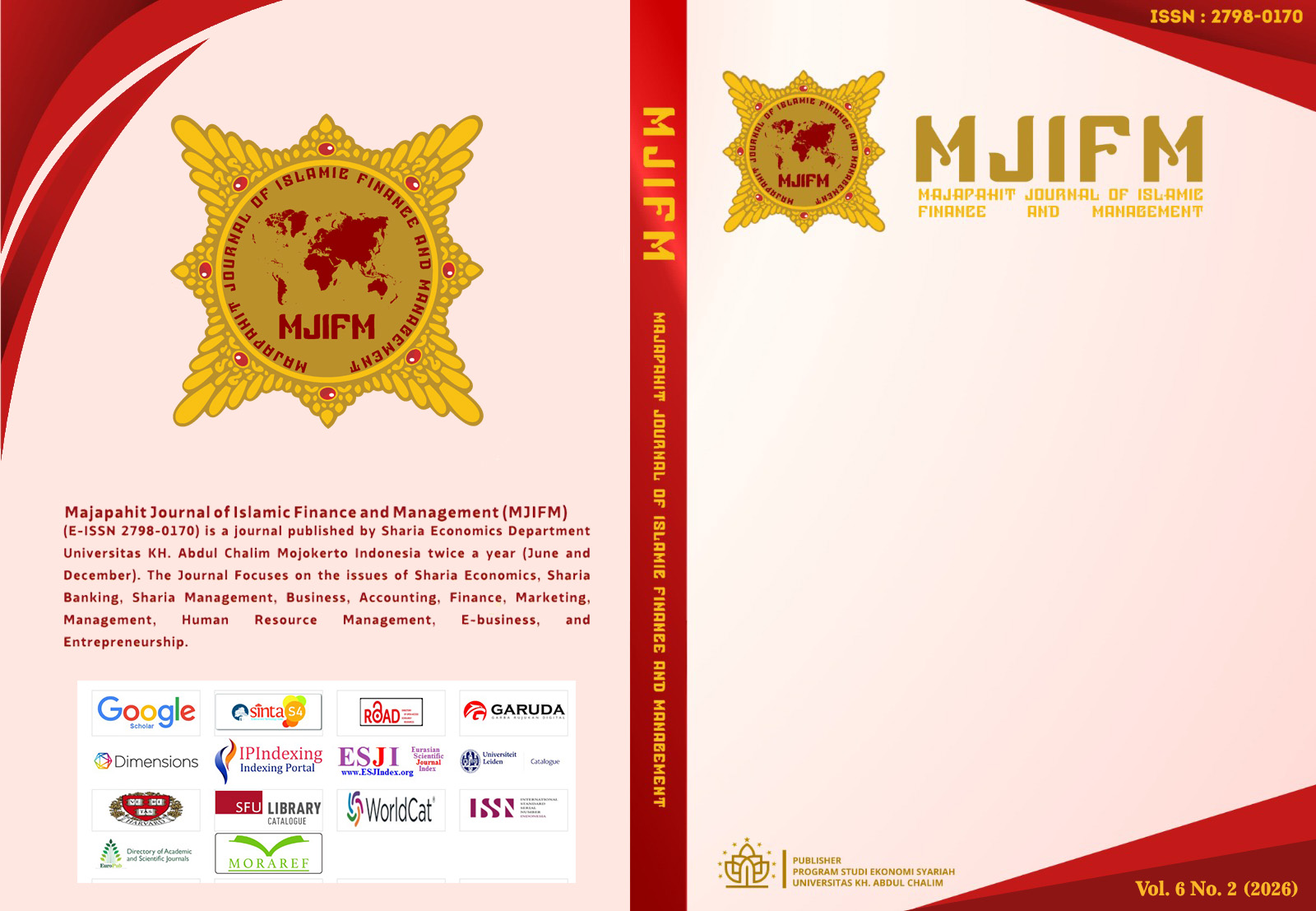
Role Stressors and Technology Perceptions as Predictors of Employee Performance in Cirebon’s Food and Beverage Industry
DOI:
https://doi.org/10.31538/mjifm.v6i2.1058Keywords:
Role Stressors; Technology Perceptions; Employee Performance; Food and Beverage Industry; PLS-SEMAbstract
This study aims to examine the effect of role stressors and technology perceptions on employee performance in the food and beverage industry in Cirebon. A quantitative explanatory approach was employed using a cross-sectional survey. Data were collected from 271 initial responses, and 250 valid responses were retained after screening. The respondents were F&B employees who had worked for at least six months and used digital technology in their work activities. The data were analyzed using Partial Least Squares Structural Equation Modeling (PLS-SEM). The results show that role stressors have a negative and significant effect on employee performance, while technology perceptions have a positive and significant effect. The model explains 42.1% of the variance in employee performance, indicating that role-related pressures and technology-related beliefs jointly contribute to performance outcomes. F&B managers should reduce role ambiguity, role conflict, and role overload by clarifying job responsibilities and improving coordination. They should also strengthen positive technology perceptions through practical training, user-friendly systems, and supportive digital work procedures.
Downloads
Published
How to Cite
Issue
Section
License
Copyright (c) 2026 Daniel Febiyanto, Bachrudin Syahroni, Moh. Yudi Mahadianto

This work is licensed under a Creative Commons Attribution-ShareAlike 4.0 International License.